Inventory buying guide
How to Plan Inventory Purchases: What to Buy, How Much to Buy and When
How Indian wholesalers, distributors, retailers and FMCG stockists decide what stock to buy, how much to order and when to place the next purchase.
For Indian wholesalers, distributors, retailers, FMCG stockists and multi-location merchants who need to buy enough without trapping cash in the wrong stock.
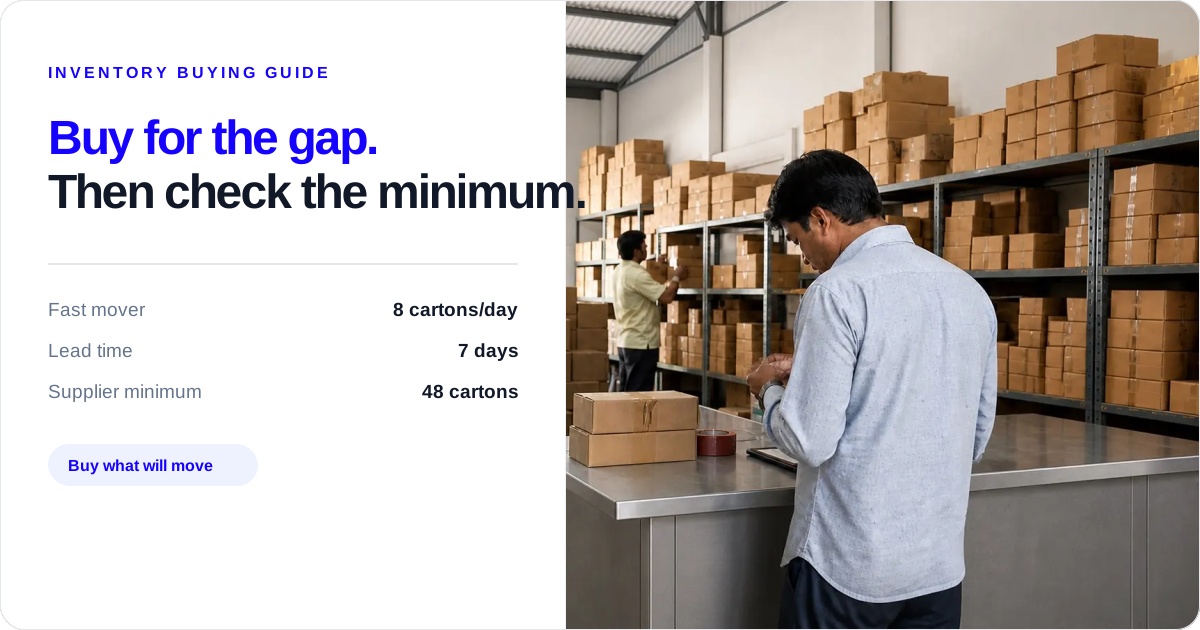
Plan an inventory purchase by checking what each location can sell, what is already committed, how long the supplier takes and how much extra stock the business can safely hold. When the supplier calls, it is tempting to say, “Send the usual lot.” That shortcut is expensive when the usual lot contains slow packs or when the stock is sitting in the wrong godown.
Start with the next retailer order or shop sale. Find the stock you can actually sell at the location that will serve it. Then work out what can move before the next delivery, what the supplier will make you take and whether the extra cartons will sit in the godown.
Start with the item and the decision window
Begin with one item, one unit and one buying window. It could be 1-litre detergent cartons for the next seven days, or a snack range needed before a festival route. “Buy more FMCG stock” is not a buying instruction. Write the item, selling unit, locations that can use it and the date when someone will look at it again.
Do not begin with the combined stock number. Ask where the next sale, retailer order or dispatch will come from. A wholesaler can have plenty in the main godown and still miss the route cut-off because the branch has no cartons. A distributor can have surplus in one city and a shortage in another. In a shop, the fast seller may be finished on the shelf while a slower variant fills the back room.
Write down four numbers for each location:
- stock you can actually sell in the selling unit;
- recent sales or outward movement over a consistent period;
- known customer, route or branch commitments before the next review; and
- the earliest date a fresh purchase or inter-godown transfer can reach the location.
Those four numbers usually tell you whether you need a purchase, a transfer or simply a better promise to the customer. A low branch balance is not automatically a purchase order.
Decide what to buy: movement first, range second
Start with what is moving, what a named customer or route needs, and what is required for a delivery promise you can actually keep. A supplier discount can wait. A larger case of a slow flavour, size or pack may be cheaper per piece, but it can also use the cash and shelf space needed for the fast seller.
If you run a shop, put the fast seller beside its substitutes. The 500-gram pack may be moving while the 1-kilogram pack sits untouched; buying both because they belong to the same range hides the real gap. A wholesaler should look at the mix retailers are actually asking for, not just the headline brand. An FMCG stockist should separate everyday sales from a festival or scheme lift before accepting a larger inward.
Slow sales deserve attention too. If an item has not moved, ask what changed: price, pack, season, customer mix or location. A dead-stock or aging report can help you find the line, but the decision is still yours—clear it, return it, move it or stop buying it for now.
Before placing a larger order, compare the money tied up in each item and godown with the stock value report guide. When the immediate problem is a branch running short, use the low-stock guide for godowns, branches and shops.
The order looked cheap until we counted the extra cartons
Buying brief
Four inputs before you choose a quantity
Keep the decision small enough to review every week and specific enough for the godown team to act on.
1 · ITEM
Name the item and unit
Use the actual carton, case, piece or kilogram that the supplier and selling team recognise.
2 · WINDOW
Set the next review date
Tie the window to supplier lead time, a route cut-off, a festival or the next buying meeting.
3 · MOVEMENT
Use location-level movement
Record how much each branch, shop or godown actually sold or dispatched.
4 · DECISION
Choose buy, transfer or hold
Write the reason beside the quantity so the next person can verify it.
Keep this simple calculation on the purchase sheet:
Purchase quantity = target stock at the next receipt + expected sales until the next review − stock expected to remain at receipt.
Do not hide the meaning behind the formula. Target stock is what you want after delivery. Expected sales is your best estimate from recent sales, known retailer orders and the season. Stock you can use means cartons that are not already promised elsewhere, damaged, blocked or likely to expire before sale.
Now put the quantity through three practical checks:
- Supplier lead time: if the supplier normally takes seven days, today’s order has to cover the sales before the cartons arrive. Use what that supplier actually takes, including dispatch and receiving time—not the optimistic promise from the last call.
- Supplier minimum and pack size: round up only when the extra quantity can be sold or stored safely. If the supplier will send at least 48 cartons and your gap is 12, the real question is what the other 36 will cost in cash, storage, expiry or future discounting.
- Cash and space: a better stock number does not make a better purchase. Check the cash due, credit terms, rack capacity, temperature or handling needs. Also ask what fast-moving item you will have to postpone if this order uses the available cash.
Do not put the same extra quantity on every line. A cushion may make sense for a reliable fast seller. Put it on a slow or short-expiry item and the cushion itself can become the loss.
Build a sales movement record you can check
Last month’s sales number needs a little explanation. Was there a wedding season, one large institutional order, a stockout, a price change or a distributor scheme? Any of these can make the average look better or worse than normal. Use a period that matches the item’s buying cycle and mark the unusual days instead of treating every day as ordinary.
For each important item, record the review period, total outward movement, number of selling days and the locations that contributed to it. If a product moved 240 cartons in 30 days, its simple average is 8 cartons a day. That does not mean every location needs 8 cartons a day: Pune may need 3, Jaipur 2 and Indore 3. The location split matters when the next retailer order must be served from one branch rather than from the business total.
Use a rough label to decide how often to look again:
- Fast movers: review frequently and protect the selling unit that customers ask for first.
- Steady movers: review on a regular cycle and align the order with the supplier’s case size.
- Slow movers: buy only when there is a named demand, a sensible range reason or a clear plan for selling the stock.
- Seasonal or event-led items: create a separate window for the event and a separate plan for what happens after it.
- Short-expiry items: use a shorter review cycle and check batch life before accepting extra quantity.
You do not need a complicated system for these labels. They give the buying team a common way to talk, so one monthly average does not decide every item.
Why the branch can be short even when the godown is full
The number in the stock book is not always ready to sell. Some cartons are already for a retailer order. Some are on tomorrow’s route. Some are at a branch that cannot send them in time. Others have too little shelf life for the customer. Write down the reason before counting them in the purchase calculation.
Walk through it in this order:
- Start with the recorded stock at the location that will serve the demand.
- Remove named sales, dispatches, collections or other commitments before the review date.
- Check open purchase inward and whether it is actually expected before the need. Do not count an unconfirmed promise as stock you can use.
- Check another location only if the item, unit, quality and movement time make it a realistic source.
- Subtract the source location’s own named demand before calling its balance surplus.
Say the main godown has 50 cartons. That does not mean the branch can take all 50: 30 are already needed for the godown route and 10 for another confirmed dispatch. Only 10 can move, before allowing for travel time or any extra cover. If the buyer looks only at the combined total, the branch can still wait—and the godown can become short after the transfer.
The question changes by merchant and by day
The same stock position can lead to a different answer on a different day. A wholesaler may accept the supplier minimum when several retailers want the mix, but reject it for a slow line that will consume this month’s cash. A distributor has to look at the branch shortage, vehicle cut-off, stock left at the source and arrival time. A transfer may save today’s dispatch while a purchase is still needed for next week.
For a retailer, the question is which fast seller deserves the next rupee before more variants are added. If the shop has 6 pieces left and sells 4 a day, a five-day supplier window matters more than the category total. A supplier minimum of 60 pieces still needs a shelf, cash and a believable time-to-sell. An FMCG stockist should check batch life, storage and the plan for scheme leftovers before accepting a larger lot.
Worked example: buy for the gap, not the combined total
Three-location buying decision
Move stock before placing a fresh order
The network has 109 cartons against an 80-carton lead-time-plus-buffer requirement. The right next move is a 23-carton transfer, not a blanket purchase.
Pune godown
- Recorded stock
- 84 cartons
- Release to Indore
- −23 cartons
- After movement
- 61 cartons
The source balance is checked against Pune’s own movement and buffer before release.
Jaipur branch
- Recorded stock
- 18 cartons
- Recent movement
- 2 cartons/day
- Role in decision
- No transfer
Keep the branch balance in the network view, but do not count it as a source without a timing check.
Indore shop
- Recorded stock
- 7 cartons
- Transfer from Pune
- +23 cartons
- After movement
- 30 cartons
Covers 21 cartons of seven-day movement plus the stated 9-carton local buffer.
Here is a detergent-carton decision across three locations. Pune has 84 cartons, Jaipur has 18 and Indore has 7. Recent sales are 3 cartons a day in Pune, 2 in Jaipur and 3 in Indore. The supplier usually takes seven days. For this example, the buyer wants three extra days of cover: all locations need 8 × 7 = 56 cartons during lead time and 8 × 3 = 24 cartons as a cushion.
The combined figure is 109 cartons, so a fresh purchase for every location is not the first move. The next-period requirement is 80 cartons. Indore’s 7 cartons still cannot cover seven days of sales and its 9-carton local cushion. After checking Pune’s own near-term need, it can release 23 cartons. Move those to Indore: Pune has 61 left and Indore has 30.
That transfer protects the short shop without buying 48 cartons when only 12 are needed. Put the next review date on the calendar anyway. If sales continue, the merchant can buy when total stock gets close to the lead-time requirement or ask the supplier for a split delivery. The 23-carton transfer is not a rule for every business; it works here because the stock sits in the right place to cover the gap.
Find the right day to place the order
Place the order when stock that can actually serve sales is getting close to the amount needed for supplier lead time and the extra cover you have chosen. Look earlier when the supplier is unreliable, a route has a fixed dispatch day, a festival is approaching, or the item takes a long time to produce or transport.
Hold or review later when the item is slow, the supplier minimum would leave months of stock, the item expires soon, the store is full, or another location has stock that can genuinely be used. A low-stock threshold tells you to investigate. It does not, by itself, mean “place a fresh order.”
For a fast seller in a shop, a weekly review may be enough when the supplier is quick and sales are steady. A distributor with a weekly retailer route should buy before the vehicle cut-off, not after the branch runs out. A wholesaler facing a high supplier minimum should put the extra cartons next to the cash required and the expected time to sell them.
Before buying, ask whether another godown can help
When one branch is short, look at three numbers: what the short location has after booked orders, what the possible source will have after its own orders, and what the business will have after the transfer. A transfer is useful only if it arrives in time and does not create a second shortage. Note the source, destination, item, quantity and movement date so the godown and branch teams are working from the same instruction.
Stock Register can give the team one place to check store-wise stock, record transfers, review remaining stock and movement fields, and find low-stock items before adding them to a purchase order. For a wholesale or distributor stock review or an FMCG distributor buying review, those records make the quantity easier to verify. When the immediate question is which shop, branch or godown can supply the next order, use location-wise stock management for that check. These records do not decide which location should give up its cartons.
One last look at cash, rack space and expiry
Once the quantity looks right, picture the rack on the next review date. If the extra cartons will still be there, a discount is not enough reason to buy them. Use the cash, space and expiry details from the earlier calculation to reduce the order, hold it or choose a transfer.
For FMCG, food, pharma or cosmetics, the one extra check is batch life. A carton with too little selling time is not equivalent to a fresh carton. Sell the older usable stock first and keep the buying window shorter for short-expiry items.
A 15-minute weekly purchase conversation
Keep the weekly conversation short enough that the team will actually have it:
- Pick the fast, slow and short-expiry lines that need attention.
- Recheck the location that will serve the next order, using the stock and commitments already written down.
- Choose one action: buy, transfer, hold, reduce the range, clear stock or revise the promise.
- After receipt, compare what arrived with what sold and change the next buying note.
The useful part is the note beside the quantity. If the supplier asks why the order is smaller, or the branch asks why stock was moved, the team can point to sales, timing and cash instead of repeating a guess.
How Stock Register fits this buying review
If the business wants a cleaner record behind this weekly conversation, Stock Register covers the relevant entries and views: purchase inward, sales outward, remaining stock, store-wise stock, recorded stock movement/history, low-stock filters, dead-stock and aging views, purchase orders, stock transfers, and batch/expiry records. Staff can be given store-wise access where the plan supports it, so the buyer, counter and godown team can check the same location record. The Low Stock Alerts, Multi-Godown Management, Stock Tracking, Staff Roles and Store Access, Stock Transfer, Batch & Expiry Tracking and Purchase Module pages explain those product features separately.
It will not forecast demand or tell you the purchase quantity. It does not track supplier lead time, optimise the supplier minimum or automate replenishment. Keep those calls with the person who knows the route, supplier, cash position and customer promise.
The purchase order should make receiving easy
A clean purchase order makes the supplier conversation shorter and the receiving check easier. For each line, confirm the item, pack or unit, quantity, agreed rate, delivery location and any batch-life requirement. Keep the supplier minimum and case multiple beside the calculation. The approver should be able to see why the final quantity is higher than the immediate gap.
If a supplier is delivering to more than one branch, group the order by destination. If the supplier cannot split the delivery, decide whether the source godown will receive and later transfer the balance, and include that movement time in the plan. Before sending, read the order as the receiving team would: can they identify the location, item and unit without calling the buyer, and does the cash due leave room for the next fast-mover purchase?
What the last delivery teaches you
The job is not over when the invoice arrives. Compare the order with the cartons that physically came in and with the purchase inward entry. Note short supply, substitutions, damaged cartons, changed batch dates or a different pack size. Fewer cartons can create a new shortage. Extra cartons can create an unexpected cash and storage problem.
When the next buying conversation comes around, compare the plan with what actually happened. Did the route sell the expected mix? Did the branch need a transfer earlier than expected? Did the supplier minimum leave too many cartons in the rack? Did the expiry window make the item harder to sell? Add one short note to the next purchase. That is enough to stop the team repeating the same order blindly.
For a fast mover, the note may change the buying day or the extra cover. For a slow mover, it may mean a smaller range, a different supplier pack or a pause. Across locations, it may show that more stock belongs at the dispatching branch and less at the central godown. You are not trying to predict perfectly; you are trying to make the next purchase with better information.
| Situation | Check first | Next move |
|---|---|---|
| Enough stock to cover the next buying period | Sales, booked orders and cash | Hold; review on the next buying date |
| One location short, another has extra stock | Stock left at source after its own orders and travel time | Transfer the gap, then reassess the purchase |
| Business is short or source cannot spare stock | Lead time, supplier minimum, expiry and cash | Buy the smallest workable quantity |
| Slow or short-expiry stock is building up | Last sale, batch expiry and storage space | Reduce, clear or pause the buy |
Enough stock to cover the next buying period
- Check first
- Sales, booked orders and cash
- Next move
- Hold; review on the next buying date
One location short, another has extra stock
- Check first
- Stock left at source after its own orders and travel time
- Next move
- Transfer the gap, then reassess the purchase
Business is short or source cannot spare stock
- Check first
- Lead time, supplier minimum, expiry and cash
- Next move
- Buy the smallest workable quantity
Slow or short-expiry stock is building up
- Check first
- Last sale, batch expiry and storage space
- Next move
- Reduce, clear or pause the buy
What Stock Register can support in this review
- Record purchase inward and sales outward, then review remaining stock and store-wise stock.
- Use low-stock, dead-stock and aging-stock views to decide which items deserve attention, and add low-stock items to a purchase order.
- Record an inter-godown transfer when one location has extra stock; use batch and expiry reports for items with a short expiry.
These records support a human buying decision. Stock Register does not forecast demand, calculate a recommended purchase, track supplier lead time, optimise the supplier minimum, or automate replenishment.
Related resources
Frequently Asked Questions
What should I check before buying inventory?⌄
Check recent sales, stock you can actually sell at every location, open customer commitments, supplier lead time, supplier minimum, cash available, storage space and expiry risk.
How do I decide how much inventory to order?⌄
Set a target that covers expected sales until the next review plus a deliberate cushion, then subtract stock you can use after considering other locations, open inward and the supplier's minimum order. Round only when the extra quantity can be sold or safely stored.
Should I transfer stock or place a fresh purchase?⌄
Transfer when another location has extra stock and it can arrive before the need. Buy when the business is short, the source would become short, or the transfer cannot arrive in time.
How does the supplier minimum and expiry change a purchase decision?⌄
A supplier's minimum order can force more quantity than the immediate gap, so compare the extra cash and storage with how quickly you can sell it. For short-expiry goods, check batch expiry before accepting a larger buy.
Can Stock Register forecast what I should buy?⌄
No. Stock Register can help you review recorded movement/history, remaining stock, store-wise stock, low-stock items, dead stock, aging, purchase orders, transfers and batch/expiry information, but the purchase quantity and timing remain a merchant decision.
Can staff check the stock at the right store before a purchase?⌄
Staff can check the store-wise record and recorded stock movement/history where their plan gives them access to that store. Confirm the exact staff/store permissions with one real item before moving the whole buying process across locations.